Tenoyim Invitation Wording (Yiddish, Hebrew & English)
How to word a Tenoyim (vort) invitation from both sides, the chosson's side or the kallah's side, with sample Hebrew/Yiddish and English wording.
What a Tenoyim invitation includes
- The heading: תנאים (Tenoyim / vort).
- The chosson's name with his parents, and the kallah's parents.
- Whose invitation it is: both sides together, the chosson's side or the kallah's side.
- The day, Hebrew date and time.
- The hall or home with the full address.
Sample wording in Hebrew / Yiddish
הננו מתכבדים להזמינכם להשתתף
בשמחת התנאים של בנינו
החתן ______ נ"י עב"ג הכלה ______ תחי'
שתתקיים אי"ה ביום ______
בשעה ______ באולם ______
הורי החתן: ______ · הורי הכלה: ______
Sample wording in English
we invite you to share our joy at the
Tenoyim of our children
______ and ______
on ______, at ______ PM
at ______, ______
Chosson's parents: ______ · Kallah's parents: ______
Quick checklist
- Agree with the other side on the names and the order before printing.
- If each side sends its own invitation, say which side on the card.
- Check the Hebrew date and the time.
- Write the hall or home address in full.
Two families, one invitation
A tenoyim invitation is different from most simcha cards because it belongs to two families. Both sets of parents are happy, both have their own relatives and friends, and both want their names written properly. That is why the wording needs a little more care: who invites, whose names come first, which titles go where, and whether the card is from both sides or from one. In this guide you will find full sample wordings for both sides together, for the chosson's side and for the kallah's side, in לשון קודש, Yiddish and English. There is also a line-by-line explanation, a table of titles, the mistakes families make most often, and a checklist to go through with the mechutonim before anything is sent.
A short note on the name: in many heimish communities the tenoyim are written at the vort, and people use the two words almost as one. In some families the tenoyim are a separate evening later on. Whichever way your family does it, the card simply says תנאים at the top and the wording below works the same way.
Both sides together: לשון קודש
This is the most common shape: one card, from both families, with the parents of the chosson and the kallah signing side by side.
בשבח והודיה להשי"ת
הננו מתכבדים להזמין את כבודו ואת ב"ב שיחיו
להשתתף בשמחת התנאים של צאצאינו
החתן המופלג ______ נ"י
עב"ג
הכלה המהוללה ______ תחי'
אשר תתקיים אי"ה בשעטו"מ
ביום ______ לסדר ______, ______ תשפ"ז לפ"ק
בשעה ______ בערב
באולם ______, ______
המצפים לקבל פניכם בשמחה
הורי החתן: הרה"ח ר' ______ הי"ו וזוגתו תחי'
הורי הכלה: הרה"ח ר' ______ הי"ו וזוגתו תחי'
צאצאינו means "our children" and is used when both families invite together, because the chosson is one family's son and the kallah is the other's daughter. On a Hebrew card the chosson's parents usually stand on the right and the kallah's parents on the left, but many families put the hosting side first. Agree on it together before the card is made.
Both sides together: Yiddish
מיט שבח והודי' צום אייבערשטן
לאדן מיר אייך הארציג איין צו נעמען אנטייל
אין דער שמחת תנאים פון אונזערע קינדער
החתן ______ נ"י
עב"ג
הכלה ______ תחי'
וואס וועט פארקומען אי"ה בשעה טובה ומוצלחת
אום יום ______ פרשת ______
______ אזייגער אוונט
אין זאל ______, ______
אייער קומען וועט פארגרעסערן אונזער שמחה
______ ומשפחתו · ______ ומשפחתו
In the Yiddish version the signature often names each father with ומשפחתו ("and his family"), which quietly includes the mothers, brothers and sisters. If you prefer, write the full parents' lines as in the לשון קודש sample.
From the chosson's side
Some families each send their own invitation, especially when each side has a big circle of friends or the families live in different cities. Then the card says clearly whose simcha it is, and names the other side with respect:
הננו מתכבדים להזמינכם להשתתף
בשמחת התנאים של בננו
החתן ______ נ"י
עב"ג הכלה המהוללה ______ תחי'
בת הרה"ח ר' ______ הי"ו
אשר תתקיים אי"ה ביום ______ לסדר ______
בשעה ______ באולם ______
ההורים: ______ ומשפחתו
From the kallah's side
הננו מתכבדים להזמינכם להשתתף
בשמחת התנאים של בתנו
הכלה ______ תחי'
עב"ג החתן המופלג ______ נ"י
בהרה"ח ר' ______ הי"ו
אשר תתקיים אי"ה ביום ______ לסדר ______
בשעה ______ בבית ______
ההורים: ______ ומשפחתו
Notice the small change: on the chosson's side card he comes first and the kallah is written as בת (daughter of) her father. On the kallah's side card she comes first and the chosson is written בהרה"ח (son of) his father. Each side writes its own child first and gives the other side's father his full title.
Mechutonim and grandparents lines
When one side invites but wants to mention the other family, a mechutonim line goes at the bottom:
הרה"ח ר' ______ הי"ו וזוגתו תחי'
ר' ______ הי"ו ומשפחתו
Grandparents are usually written under the parents as זקני החתן and זקני הכלה:
זקני הכלה: הרה"ח ר' ______ הי"ו · מו"ה ______ הי"ו
Some families leave grandparents off a tenoyim card and keep them for the wedding invitation; others always include them. If one side includes grandparents, it is kind for the other side to do the same, so that the card looks balanced.
Sample wording in English, both sides
together with our mechutonim
we invite you to share our joy at the
Tenoyim of our children
______ and ______
on ______, Parshas ______
______ 2026, at ______ PM
at ______, ______
Mr. and Mrs. ______ · Mr. and Mrs. ______
A single-side English card can read: "Mr. and Mrs. ______ invite you to the Tenoyim of their son ______ to ______, daughter of Mr. and Mrs. ______." Keep the English short. Guests who read English mostly want the names, the day, the time and the place.
Line by line: what each phrase means
| Phrase | Meaning | Notes |
|---|---|---|
| בס"ד / ב"ה | B'siyata d'Shmaya / Baruch Hashem | At the top. Use one of them. |
| שמחת התנאים | The simcha of the tenoyim | The heading of the event. |
| צאצאינו | Our children | When both families invite together. |
| בננו / בתנו | Our son / our daughter | When one side invites. |
| החתן המופלג | The distinguished chosson | A common title of praise for the chosson. Optional. |
| הכלה המהוללה | The praised kallah | A common title for the kallah. Optional. |
| עב"ג | עם בת גילו | "With his match". Joins the chosson and the kallah. |
| בת / בהרה"ח | Daughter of / son of | Names the other side's father. |
| בשעטו"מ | בשעה טובה ומוצלחת | "In a good and successful hour". A blessing used for engagements. |
| אשר תתקיים אי"ה | Which will take place, if Hashem wills | Before the date. |
| המחותנים | The in-laws | The other side's parents. |
| זקני החתן / זקני הכלה | The chosson's / kallah's grandparents | Under the parents' lines. |
| המצפים לקבל פניכם בשמחה | Looking forward to greeting you joyfully | Above the signatures. |
Titles on a tenoyim card
| Title | Full form | Use |
|---|---|---|
| נ"י | נרו יאיר | After the chosson's name. |
| תחי' | תחיה | After the kallah's name, and after each mother: וזוגתו תחי'. |
| הי"ו | ה' ישמרהו ויחייהו | After each father and grandfather. |
| הרה"ח | הרב החסיד | Before a father's or grandfather's name. |
| מו"ה | מורנו הרב | A formal title, often for grandfathers. |
| בהרה"ח | בן הרב החסיד | "Son of", after the chosson's name on the kallah's side card. |
| שליט"א | שיחיה לאורך ימים טובים אמן | After a rav's or rebbe's name, for example a grandfather who is a rav. |
| ז"ל / ע"ה | זכרונו לברכה / עליו השלום | After a grandparent who has passed away. |
The most important rule on a tenoyim card is balance. If one father is written הרה"ח ר', the other father should be too. If one mother is written וזוגתו תחי', write the other mother the same way. Families notice these small things, and getting them even is a way of showing respect to the new mechutonim.
Date, time and place
The date line on a tenoyim card is the same as on any heimish invitation: the day as a letter, the parsha, the Hebrew date and the year with לפ"ק, for example ביום ג' לסדר לך לך, ט' מרחשון תשפ"ז לפ"ק, בשעה 8:00 בערב. A tenoyim evening often starts at night, and the Hebrew day begins at nightfall, so check that the Hebrew date matches the night you mean. Many families add the English date on an English side to make it simple.
Many tenoyim take place in the kallah's parents' home, and some in a hall. If it is at home, write בבית הורי הכלה or אין שטוב פון די עלטערן פון דער כלה with the full address. If it is in a hall, write the hall's name as it appears on its sign and the street and number. If men and women have separate entrances, a short line helps guests: כניסה לנשים מצד ______.
Common mistakes to avoid
- Not checking with the other side. Send the final text to the mechutonim before anyone sees it. Names, titles and order should be agreed on by both families.
- Uneven titles. One father with הרה"ח and the other with only ר' can hurt feelings. Keep them the same.
- Spelling the other family's names. Ask them to type their names for you, exactly as they write them.
- Saying "our son" on a both-sides card. On a shared card write צאצאינו (our children), not בננו.
- No side on a one-side card. If each family sends its own, make clear whose invitation it is in the signature.
- The wrong Hebrew date for an evening event. Remember that the night belongs to the next Hebrew day.
- Forgetting the address. "At the kallah's home" is not enough for guests from out of town.
Checklist to go through with the mechutonim
- One card from both sides, or one card per side?
- The chosson's name with נ"י and the kallah's name with תחי'.
- Both fathers' names with the same titles (ר', הרה"ח or מו"ה) and הי"ו.
- Both mothers written the same way.
- Grandparents on both sides, or on neither.
- Which side comes first on the card.
- The day, parsha, Hebrew date and year with לפ"ק.
- The time, and whether it is evening.
- The home or hall with the full address.
- Both families have read the final card once before it is sent.
Make your Tenoyim card on our site, step by step
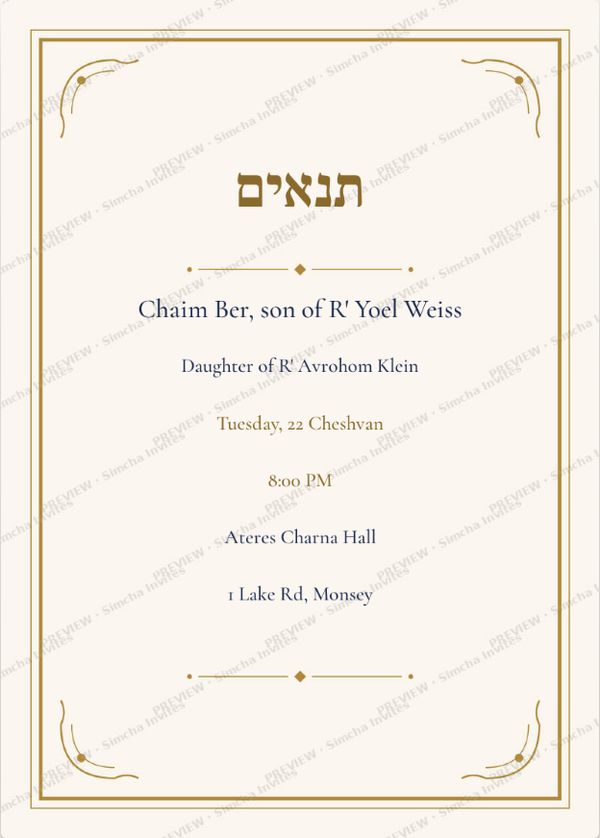
- Pick the design. Open the Tenoyim designs and tap the one you like. The heading is already part of the picture, so you never type it.
- Type each box. Every box has a label that says what it is for: the chosson's and kallah's names, the parents of both sides, the date, the time and the place. You can type in Hebrew, Yiddish, English or a mix. You can also tap a line on the card to jump straight to its box.
- Choose a font and size. Each box has its own font picker and A− / A+ buttons. Many families pick a bold Hebrew font for the chosson's and kallah's names and a quiet one for the details. Before paying, send a screenshot of the preview to the mechutonim so both sides agree on every name.
- Check the preview. The card updates as you type. Look at it once at phone size, because that is how most guests will see it. The preview has a watermark; the paid files do not.
- Place the order and pay. The price is $15. On designs that have an animated GIF version, you can add the GIF for a small extra.
- Download your 3 files. Right after paying you get a print PDF (letter size), a Full quality JPG for printing (2550 px wide, 300 dpi) and a Small – for texting JPG under 1 MB for WhatsApp, text messages and email. GIF orders also get the GIF and a small GIF. Save the page so you can download again later.
For how to send the small file to many people at once, see our guide to sending simcha invitations on WhatsApp or by text.
Both Sides, Chosson's Side or Kallah's Side card
Our Tenoyim category has a Both Sides design (Tenoyim – Ivory Frame), and its text boxes take the wording of either family. What changes is who is sending the card:
| Card | Who sends it | Whose name comes first |
|---|---|---|
| Both Sides | Both families together | Usually the chosson, then עב"ג the kallah |
| Chosson's Side | The chosson's parents, to their circle | The chosson; the kallah as בת her father |
| Kallah's Side | The kallah's parents, to their circle | The kallah; the chosson as בהרה"ח his father |
There are also 10 Tenoyim Frame designs: decorative frames in different styles, such as Gold Filigree, Watercolor Flowers, Navy & Gold Art Deco, Black & Gold Classic, Pomegranate & Vine, Marble & Gold Arch, Classic Double Line, Pastel Roses, Burgundy & Gold Crown and Minimal Gold Leaf. If each side sends its own card, many families still choose the same design, so the two cards look like a pair. Each card is its own order at $15.
Customs differ, and that is fine
Every kehilla has its own way of doing a tenoyim, and the card should follow the families, not a template. Many families write the whole card in לשון קודש; others write the opening in לשון קודש and the rest in Yiddish, and some add an English side for relatives abroad. Some families add praise titles such as החתן המופלג and הכלה המהוללה, while others prefer just the names with נ"י and תחי'. In some circles the tenoyim are written the same night as the vort, in the kallah's parents' home, with only close family and friends; in others there is a larger evening in a hall. Some families print the name of the rebbe or rav who will be present, and many do not. None of these is more correct than the other. If the two families come from different backgrounds, it is a good idea for the parents to talk it over once, choose one style, and use it for the whole card.
A short message to send with the card
When you send the invitation on WhatsApp, a short line above the picture makes it personal. Here are a few you can copy:
מיר פרייען זיך צו מעלדן די תנאים פון אונזער זון ______ נ"י
עס וועט אונז זייער פרייען אייך צו זען
מיט פיל דאנק, ______ ומשפחתו
We would love for you to join us. The invitation is attached.
With thanks, the ______ family
Keep the message short and let the invitation speak for itself. A day before, a short reminder with the time and address is helpful, especially for guests coming from another neighbourhood.
When guests are coming from out of town
A tenoyim is often planned quickly, and relatives may come from another city or even another country. If many guests are travelling, a few small details on the card or in the WhatsApp message save them phone calls: the full address with the city, the time in the evening (and that it is local time), and a phone number of a family member who can help with directions. Do not crowd the card itself; one extra line at the bottom is enough, and the rest can go in the message. If the families plan a second evening for out-of-town relatives, make a separate card for it rather than putting two events on one design, so each card stays clear and easy to read.

More complete samples for different family situations
At the kallah's grandparents' home (lashon kodesh)
בשבח והודי' להשי"ת
הננו מתכבדים להזמין את כל קרובינו ומכירינו
להשתתף בשמחת התנאים
של צאצאינו
החתן ______ נ"י עב"ג הכלה ______ תחי'
אשר תתקיים אי"ה ביום ______ לסדר ______ בשעה ______
בבית זקני הכלה, הרה"ח ר' ______ הי"ו
______ (address)
______ ומשפחתו · ______ ומשפחתו
When a parent is no longer alive
The surviving parent invites, and the parent who passed away is mentioned with ז"ל or ע"ה in the line that names the chosson or kallah. Families feel strongly about this line, so ask them how they want it written.
הנני מתכבדת להזמינכם להשתתף בשמחת התנאים
של בני החתן ______ נ"י
בן הרה"ח ר' ______ ז"ל
עב"ג הכלה ______ תחי'
בת הרה"ח ר' ______ הי"ו
אשר תתקיים אי"ה ביום ______ פרשת ______ בשעה ______
באולם ______
מרת ______ תחי' ומשפחתה
Same-night tenoyim, a WhatsApp notice (Yiddish)
In many chassidish families the tenoyim are written the same night as the engagement, so there is no time for a card. A short message goes out, and a card may follow for a larger evening.
מזל טוב! מיר פרייען זיך צו מעלדן די שידוך
פון אונזער זון ______ נ"י
מיט ______ תחי', טאכטער פון ר' ______ הי"ו
תנאים היינט ביינאכט 10:30
אין שטוב פון די עלטערן פון דער כלה, ______
Yeshivish style, in English
Together with their families
Rabbi and Mrs. ______ and Mr. and Mrs. ______
invite you to the
Tenaim
of their children
______ and ______
Sunday evening, ______, at 8:00 PM
at ______ (address)
Yeshivish families often spell it "Tenaim" and may hold it at the vort. For the difference between the l'chaim, the vort and the tenoyim, see our vort and l'chaim wording guide.
Timing and Shabbos notes
- Motzei Shabbos tenoyim. Send the card before Shabbos and give a time that leaves guests room after havdalah.
- A planned evening in a hall. Common practice is to send the card about a week ahead, and a short reminder the day before.
- The chasuna card comes later. Use the same spelling of the names on the tenoyim card and on the chasuna card. Our chasuna invitation wording guide covers the wedding card.
More timing for every simcha is in our guide on when to send simcha invitations.
More mistakes to avoid
- Two different frames for one couple. If each side sends its own card, agree on the design first.
- Sending the full-quality file on WhatsApp. Send the small texting JPG instead; it opens faster and stays sharp on simple phones.
- Changing a name after the other side sent its card. If one card is corrected, tell the other family so both match.
Frequently asked questions
What does עב"ג mean on a tenoyim invitation?
עם בת גילו, "with his match". It joins the chosson's name to the kallah's name.
Who sends the tenoyim invitation?
Many families send one card from both sides together. Some send a separate card from each side. Both are fine; agree on it with the mechutonim.
Whose parents go first?
Often the chosson's parents are written first (on the right of a Hebrew card), and some families put the hosting side first. Decide together.
Should grandparents be on a tenoyim card?
Some families include them as זקני החתן and זקני הכלה; others keep them for the wedding invitation. If one side includes them, the other usually does too.
What is the difference between בננו and צאצאינו?
בננו means "our son" and is used when one side invites. צאצאינו means "our children" and is used when both families invite together.
Do both families need to order separately?
Only if each side sends its own card. A Both Sides card is one order. A Chosson's Side card and a Kallah's Side card are two orders, $15 each.
Which file should we send on WhatsApp?
Send the Small – for texting JPG. It is under 1 MB, so it opens fast on WhatsApp and picture messages. Print the PDF if you want paper copies.
How do we write a parent who has passed away?
The parent is usually mentioned with ז"ל or ע"ה in the line that names the chosson or kallah, such as בן הרה"ח ר' ______ ז"ל. Ask the family how they want it written.
Should we write "Tenoyim" or "Tenaim" in English?
Both are correct. Chassidish families usually write Tenoyim, and yeshivish families often write Tenaim. Use the spelling your guests know.
What are the Tenoyim Frame designs?
They are 10 decorative frame designs in the Tenoyim category, in styles such as Gold Filigree, Pastel Roses and Minimal Gold Leaf. As of November 2026 they come without text boxes, so if you want to type your own wording on the card, use the Tenoyim – Ivory Frame design.