Chasuna Invitation Wording: Heimish Wedding Card Samples (Hebrew, Yiddish & English)
How a heimish chasuna invitation is laid out, line by line, with complete sample wordings in lashon kodesh, Yiddish and English, the date and year formats, grandparents, both-sides and one-side cards, and the WhatsApp message to send with it.
Updated November 8, 2026
A chasuna card is the most-read card a family sends
A chasuna (חתונה) is the biggest simcha most families make. The invitation goes to hundreds of people: family near and far, the shul, the yeshiva, the chosson's friends, the kallah's school friends, neighbors, business contacts. Guests keep it on the fridge or in their phone for weeks and look at it again on the day to check the time and the hall. That is why every line matters.
Heimish chasuna cards follow a pattern that has hardly changed in generations. Once you know the pattern, you can fill it in quickly and avoid the small mistakes that cause phone calls later, such as a missing year, a chuppah time that is not clear, or a hall name with no address.
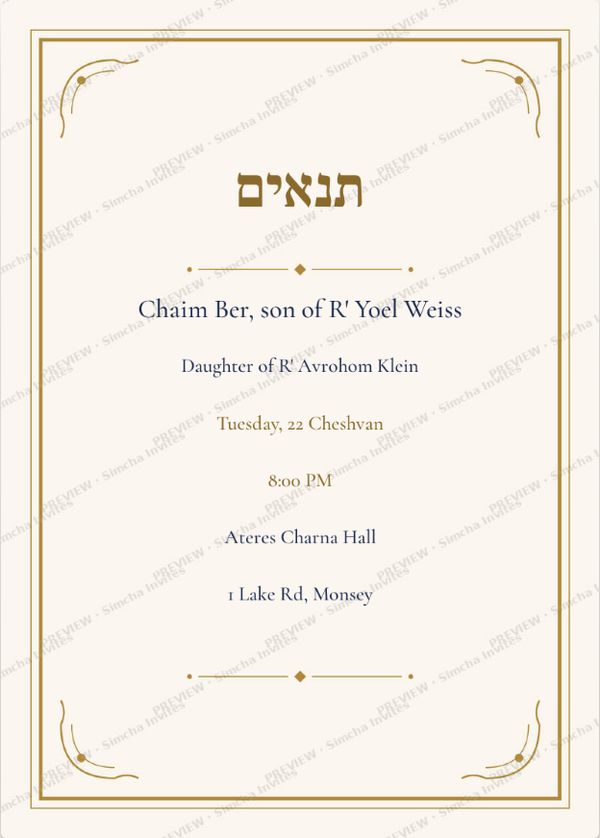
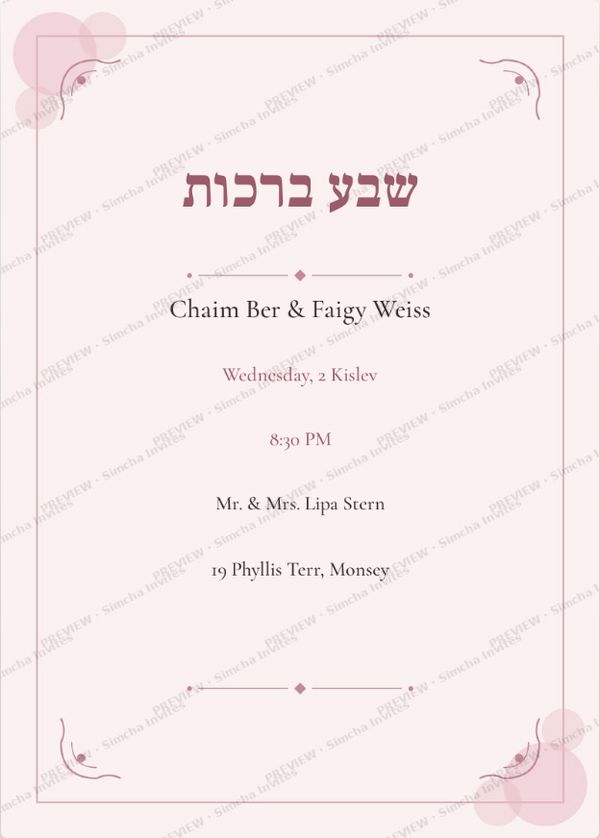
An honest note first: Simcha Invites does not sell chasuna designs yet. Most families order the chasuna card from a printer or a designer. What we do have are designs for the events around the chasuna: Tenoyim, Bavarfen for the Shabbos before, and Sheva Brachos for the week after. This guide gives you the wording for the chasuna card itself, which you can hand to your printer or designer.
What goes on a heimish chasuna invitation
Almost every heimish card has these parts, in this order, from top to bottom:
- The opening at the top: בעזהשי"ת (with the help of Hashem), ב"ה or בס"ד. Most families use the same one on every card they send.
- The thanks to Hashem: for example בשבח והודי' להשי"ת or ברגשי שמחה ותודה להשי"ת.
- The invitation line: הננו מתכבדים להזמין את כבודו ואת ב"ב שיחיו ("we are honored to invite you and your household").
- The simcha: לבוא ולהשתתף בשמחת נישואי צאצאינו היקרים ("to come and share in the wedding of our dear children").
- The chosson, under the word החתן, with his titles and נ"י after his name.
- The kallah, under the word הכלה (often joined with עב"ג, "with his match"), with תחי' after her name.
- The date: the day of the week, the parsha, the Hebrew date and the year, usually with לפ"ק at the end.
- The times: the kabbolas ponim (קבלת פנים) and the chuppah (החופה), often with בדיוק ("exactly") or בשעה טובה ומוצלחת.
- The place: the hall's name and the full street address, with the city.
- The signatures: the parents of both sides, often under המתכבדים ("those who are honored"), and in many families the grandparents too.
Some families add a small line at the bottom or on a separate slip: the Sheva Brachos schedule, the mitzvah tantz, a bus from out of town, or a phone number for directions. More on those below.
The classic both-sides card in lashon kodesh
This is the most common layout in chassidish and yeshivish homes. Both families invite together, and both sets of parents sign at the bottom, side by side.
בשבח והודי' להשי"ת
הננו מתכבדים להזמין את כבודו ואת ב"ב שיחיו
לבוא ולהשתתף בשמחת נישואי צאצאינו היקרים
החתן
הבחור המופלג בתורה ויראת שמים
כמר ___ נ"י
עב"ג הכלה
המהוללה ___ תחי'
שתתקיים אי"ה בשעטו"מ
ביום ___ לסדר ___
___ לחודש ___ שנת תשפ"ז לפ"ק
קבלת פנים בשעה ___
החופה תהי' בשעה ___ בדיוק
באולם ___
___ (address, city)
המתכבדים
___ וזוגתו · ___ וזוגתו
A few notes on this card:
- לסדר before the parsha means "in the week of the reading of". Some write פרשת instead; both are correct.
- Titles for the chosson differ by family and circle. הבחור המופלג בתורה ויראת שמים is very common. Some families keep it short: החתן ___ נ"י. If the chosson learns in a yeshiva, some families add the yeshiva's name on the next line.
- בדיוק after the chuppah time tells guests the time is real, not a rough guide. Only write it if the families really mean it.
A fuller chassidish card with grandparents
Many chassidish families list the grandparents. They often appear under זקני החתן and זקני הכלה, or in one line under הזקנים. Titles such as הרה"ח (הרב החסיד) and הרה"ג (הרב הגאון) are used the way the family is used to; when in doubt, ask the grandparents how they write their own names.
ברגשי שמחה וגיל ובשבח והודי' להשי"ת
הננו מתכבדים בזה להזמין את כבודו ואת ב"ב שיחיו
להשתתף בשמחת נישואי צאצאינו היקרים
החתן המופלג בתוי"ר ___ נ"י
עב"ג
הכלה המהוללה ___ תחי'
שתתקיים אי"ה בשעטו"מ
ביום ___ פרשת ___ ___ לחודש ___ תשפ"ז לפ"ק
קבלת פנים לחתן ולכלה: בשעה ___
החופה תהי' תחת כיפת השמים בשעה ___
באולם ___, ___ (address)
המתכבדים
הורי החתן: ___ וזוגתו
הורי הכלה: ___ וזוגתו
זקני החתן: הרה"ח ר' ___ · הרה"ח ר' ___
זקני הכלה: הרה"ח ר' ___ · הרה"ח ר' ___
החופה תהי' תחת כיפת השמים means "the chuppah will be under the open sky", which many heimish families keep. If the chuppah is outside the hall (a courtyard or a roof), say so on the card so guests know to bring a coat in the winter.
When a grandparent has passed away, many families write ז"ל after a man's name and ע"ה after a woman's name, or leave the deceased grandparents off the card. Customs differ; ask the family what they prefer.
A one-side card
Sometimes each side sends its own card, for example when the families live in different cities, or when one side invites a very large circle (a shul, a yeshiva, a business) that the other side does not know. A one-side card names only that side's parents as the inviters, but still names both the chosson and the kallah.
From the kallah's parents
בשבח והודי' להשי"ת
הננו מתכבדים להזמין את כבודו ואת ב"ב שיחיו
לבוא ולהשתתף בשמחת נישואי בתנו
הכלה ___ תחי'
עב"ג החתן ___ נ"י
בן ר' ___ הי"ו
שתתקיים אי"ה בשעטו"מ
ביום ___ פרשת ___ ___ לחודש ___ תשפ"ז לפ"ק
קבלת פנים בשעה ___ · החופה בשעה ___
באולם ___, ___
המתכבדים
___ וזוגתו
From the chosson's parents
הננו מתכבדים להזמין את כבודו ואת ב"ב שיחיו
להשתתף בשמחת נישואי בננו
החתן ___ נ"י
עב"ג הכלה ___ תחי'
בת ר' ___ הי"ו
שתתקיים אי"ה בשעטו"מ
ביום ___ פרשת ___ ___ לחודש ___ תשפ"ז לפ"ק
החופה בשעה ___
באולם ___, ___
המתכבדים
___ וזוגתו
On a one-side card it is polite to name the other side's father (בן ר' ___ or בת ר' ___), so guests know which family the chosson or kallah comes from.
Sample wording in Yiddish
Many chassidish families prefer Yiddish, or send a Yiddish card to family and a lashon kodesh card to the wider circle. A warm Yiddish both-sides card:
מיט גרויס פרייד און דאנק צום אייבערשטן
ווילן מיר אייך הערצליך בעטן צו קומען
און זיך משתתף זיין אין דער חתונה
פון אונזערע טייערע קינדער
דער חתן ___ נ"י
מיט דער כלה ___ תחי'
וואס וועט זיין אי"ה בשעטו"מ
___ טאג, פרשת ___, ___ ___ תשפ"ז
קבלת פנים: ___ אזייגער
חופה: ___ אזייגער פונקטליך
אין זאל ___, ___ (address)
מיר ווארטן אייך מיט פרייד
___ און משפחה · ___ און משפחה
A shorter Yiddish version, often used for the card sent to the shul or to neighbors:
איר זענט הערצליך איינגעלאדנט
צו דער חתונה פון
___ נ"י מיט ___ תחי'
___ טאג, פרשת ___ · חופה ___ אזייגער
זאל ___, ___
___ און ___
Spell the day in Yiddish the usual way: זונטאג, מאנטאג, דינסטאג, מיטוואך, דאנערשטאג. Weddings are rarely on Friday or Shabbos, so those days seldom appear. Motzei Shabbos weddings are written מוצאי שבת קודש or במוצש"ק.
Sample wording in English
Families with relatives or friends who don't read Hebrew often send an English card, or print English on the back of the Hebrew card. In heimish and yeshivish English cards, the style stays modest and simple.
Both sides, yeshivish style
With gratitude to Hashem
Mr. and Mrs. ___ ___
Mr. and Mrs. ___ ___
request the pleasure of your company
at the marriage of their children
___
and
___
on ___day, the ___ of ___, 5787
(___ ___, 20__)
Kabbolas Ponim at ___ PM
Chuppah at ___ PM sharp
___ Hall, ___ (address, city)
Simple English, for neighbors and work friends
the ___ and ___ families
invite you to the wedding of
___ & ___
___day, ___ ___
Chuppah ___ PM · ___ Hall, ___
Which family is named first is a family custom. Many cards put the two families side by side; the mechutonim usually agree on the order before the card goes to the printer. In English, give both the Hebrew date and the regular date, because guests use the regular date for travel and work.
Hebrew on the front, English on the back
A bilingual card is easy to read if the two languages do not mix line by line. Put the full Hebrew or Yiddish card on the front. On the back, give a short English summary: whose wedding, the date in both calendars, the chuppah time and the full address. A short bilingual sample for the back:
___day, ___ ___ / ___ ___ 5787
Kabbolas Ponim ___ PM · Chuppah ___ PM
___ Hall, ___ (full address)
Directions: ___ (phone)
The date and the year: how to write them
The date is where most mistakes happen, so it is worth getting the format right.
- Day of the week: ביום א' (Sunday), ביום ב' (Monday), ביום ג' (Tuesday), ביום ד' (Wednesday), ביום ה' (Thursday). Motzei Shabbos is במוצש"ק.
- The parsha: פרשת ___ or לסדר ___, the parsha read on the Shabbos of that week.
- The Hebrew date: the day in Hebrew letters and the month, for example ט"ו לחודש שבט. Write ט"ו and ט"ז for 15 and 16, never the letters of Hashem's name.
- The year: this year is תשפ"ז (5787), which began in September 2026. Most cards add לפ"ק (לפרט קטן, "by the short count", meaning without the thousands). Some write שנת תשפ"ז לפ"ק, some only תשפ"ז.
- A "prat": some chassidish cards write the year as a short phrase, often from the parsha of the week, with marked letters that add up to the year. It is a nice custom, but check the count twice, or ask someone who is used to it.
Evening weddings and the Hebrew date: the Jewish day begins at night. If the chuppah or the meal runs after sunset, the Hebrew date has already moved to the next day. Families handle this in different ways on the card (some write the date of the day, some write אור ליום). If you are not sure which date to write, ask your Rav. Our timing guide, when to send simcha invitations, explains the night-before rule in more detail.
What each phrase means
| On the card | Meaning | Where it goes |
|---|---|---|
| בעזהשי"ת | With the help of Hashem, may He be blessed | Top line |
| בשבח והודי' להשי"ת | With praise and thanks to Hashem | Opening |
| את כבודו ואת ב"ב שיחיו | You and your household, may they live | Invitation line |
| צאצאינו היקרים | Our dear children | Before the names |
| המופלג בתוי"ר | Outstanding in Torah and fear of Heaven | Before the chosson's name |
| נ"י | May his light shine (after a young man's name) | After the chosson's name |
| עב"ג | With his match (עם בת גילו) | Between chosson and kallah |
| תחי' | May she live (after a woman's or girl's name) | After the kallah's name |
| בשעטו"מ | In a good and successful hour | Before the date |
| אי"ה | If Hashem wills | Before the date or time |
| לפ"ק | By the short count (the year without thousands) | After the year |
| קבלת פנים | The reception before the chuppah | Times |
| הי"ו | May Hashem guard him and give him life | After a married man's name |
| המתכבדים | Those who are honored (the inviters) | Above the signatures |
For many more abbreviations, see our Yiddish and Hebrew invitation abbreviations guide.
Extra lines some families add
The mitzvah tantz
In many chassidish families the mitzvah tantz at the end of the seudah is a highlight for close family and chassidim. Most cards don't mention it. Some families add a small line, or tell close relatives separately, so those who come late know roughly when it starts. A simple line:
The Sheva Brachos
Some families print a short line or a small separate card with the Sheva Brachos nights, so relatives can plan ahead. Others send each Sheva Brachos invitation separately during the week. A short line for the chasuna card:
For full wording and a schedule for all seven days, see our Sheva Brachos invitation wording guide.
Transport and directions
For a chasuna in another city, many families add a line about a bus, or a phone number for directions:
לפרטים: ___
The envelope and the address line
A printed card in an envelope is still common for close family and for the shul. The envelope is usually addressed in Hebrew, with the titles the family uses for that person:
הרה"ח ר' ___ הי"ו
וב"ב שיחיו
___ (address)
For a family where the couple is invited together, לכבוד ר' ___ ומשפחתו הי"ו is common. Write the English address under the Hebrew if the card goes by mail, so the mail carrier can read it.
The WhatsApp message to go with the card
Today most guests get the chasuna card as a picture on WhatsApp or by text, even if a printed card follows. Send the picture with a short line of text, so the message makes sense in a busy chat. In Yiddish:
מיט גרויס פרייד לאדענען מיר אייך איין
צו דער חתונה פון ___ נ"י מיט ___ תחי'
___ טאג, פרשת ___ · חופה ___ אזייגער
___ זאל · מיר ווארטן אייך!
In English:
Send the smaller picture file, not the huge print file, so it opens fast and does not get blurry or fail on simple phones. Our guide on sending simcha invitations on WhatsApp or by text explains broadcast lists, flip phones and reminders step by step.
When to send a chasuna invitation
Printed chasuna cards are commonly sent about four to six weeks before the chasuna, and earlier for guests who must travel. A WhatsApp reminder a day or two before is common. These are habits, not rules; some families send earlier or later. Our timing guide for simcha invitations has a full table for every simcha, including the Shabbos and Yom Tov points.
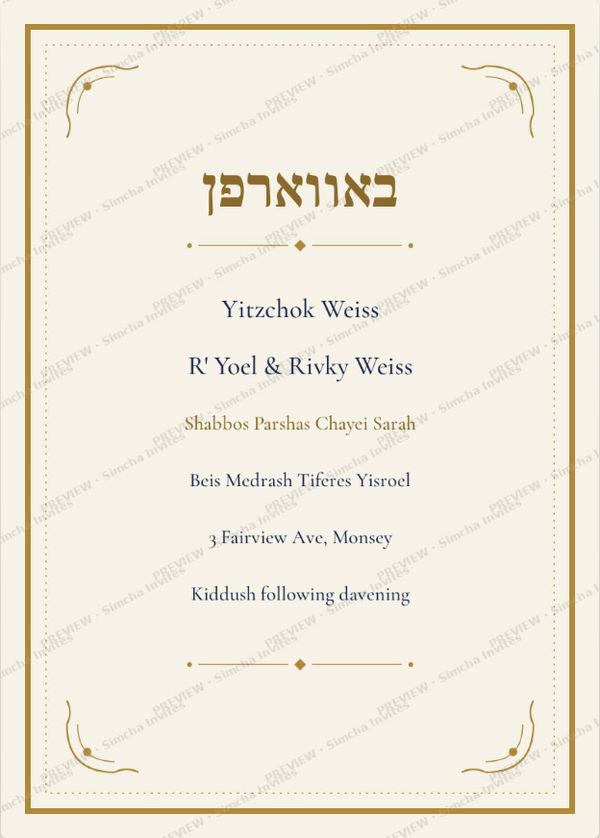
Making the cards for the events around the chasuna on our site
We don't have chasuna designs, but a chasuna comes with other simchas that each need their own card, and those we do have. Here is how it works for any of them, step by step:
- Pick the event. Open the Tenoyim, Bavarfen or Sheva Brachos category. Each design has its heading built in, for example תנאים, באווארפן or שבע ברכות.
- Pick a design. Tap it to open the editor. The card shows on top and the text boxes below.
- Type each box. You can type English, Hebrew, Yiddish or mixed. The preview updates as you type.
- Choose a font and size. Each text box has its own font picker and A−/A+ buttons. Use Reset to go back to the design's default size.
- Check the preview. Look at it the way a guest will, on a phone. Check every name, the parsha, the date and the address. The preview has a watermark until you pay.
- Order and pay. Each invitation is $15.
- Download your 3 files: a print PDF, a "Full quality – for printing" JPG (2550 px wide, 300 dpi), and a "Small – for texting (MMS), under 1 MB" JPG for WhatsApp, text messages and email.
For wording help on each one, see our Tenoyim wording guide, our Bavarfen wording guide and our Vort and L'chaim wording guide.
Common mistakes on chasuna cards
- No year, or the wrong year. A card for a chasuna after Rosh Hashana must say תשפ"ז, not last year's תשפ"ו. Copying an old card is the usual cause.
- The chuppah time is unclear. If there is a kabbolas ponim and a chuppah, write both times, each on its own line.
- A hall name with no address. Out-of-town guests and taxi drivers need the street and the city.
- Day and date don't match. Check the day of the week against the Hebrew date in a luach. One wrong letter sends guests on the wrong night.
- Names spelled differently on two cards. If each side prints its own card, agree on the spelling of the chosson's and kallah's names first.
- A title the family doesn't use. Ask before adding titles to a grandparent's or a Rov's name.
- Sending the huge print file on WhatsApp. It may arrive blurry or not open on simple phones. Send the small file.
- Too much on one card. Directions, buses and the Sheva Brachos schedule can go on a second card or a follow-up message.
Checklist before the card goes to print
- Opening line (בעזהשי"ת or the family's usual one) at the top.
- Chosson's and kallah's names spelled the way both families agreed, with נ"י and תחי'.
- Day of the week, parsha, Hebrew date and year, checked in a luach.
- Regular date on the English side.
- Kabbolas ponim time and chuppah time.
- Hall name, street, city.
- Both sets of parents, and grandparents if you list them, spelled correctly with the right titles.
- Agreed order of the two families.
- Any extra lines (bus, Sheva Brachos, mitzvah tantz) checked.
- A second person has read the card slowly, out loud.
- A small picture file ready for WhatsApp and text.
Frequently asked questions
Do you sell chasuna invitation designs?
Not yet. Simcha Invites has designs for the simchas around a chasuna: Tenoyim, Bavarfen and Sheva Brachos, each $15. For the chasuna card itself, use this wording with a printer or a designer.
Who invites on a heimish chasuna card?
Usually both sets of parents together, signed side by side under המתכבדים. Sometimes each side sends its own card, naming only its own parents as the inviters.
Do the grandparents go on the card?
Many chassidish families list them under זקני החתן and זקני הכלה; many yeshivish and English cards leave them off. It is a family choice.
What does עב"ג mean?
It stands for עם בת גילו, "with his match", and joins the chosson's name to the kallah's name on the card.
What does לפ"ק after the year mean?
It stands for לפרט קטן, "by the short count": the year is written without the thousands, so 5787 is written תשפ"ז.
Should the card show both the Hebrew and the regular date?
A Hebrew card usually gives only the Hebrew date. If you add English, give both, because guests plan travel and work by the regular date.
What is the kabbolas ponim?
It is the reception before the chuppah, where guests greet the chosson and the kallah. On the card it gets its own time, before the chuppah time.
Which date do I write for a chuppah after sunset?
The Jewish day starts at night, so after sunset the Hebrew date is already the next day. Families write this in different ways; if you are unsure, ask your Rav.
Should the mitzvah tantz go on the card?
Most cards don't mention it. Some chassidish families add a short line with an approximate time, or tell close family separately.
How early should chasuna invitations go out?
Commonly about four to six weeks before for printed cards, earlier for out-of-town guests, with a short reminder a day or two before. See our timing guide.
Can I send the chasuna card on WhatsApp?
Yes, most guests now get it that way. Send a small picture file with a short line of text. Our WhatsApp and text guide explains it step by step.
Where can I make the Sheva Brachos and Tenoyim cards?
On Simcha Invites: pick a design in Sheva Brachos or Tenoyim, type your text, preview it, and download a print PDF, a full-quality JPG and a small texting JPG for $15.