Sheva Brachos Invitation Wording, with a 7-Night Schedule Template
How to word a Sheva Brachos (שבע ברכות) invitation for a host's night and a schedule card for the whole week, with samples in Hebrew, Yiddish and English, a fill-in table for all seven days, the Shabbos meals, and a WhatsApp version.
Updated November 8, 2026
What Sheva Brachos are
After the chasuna, the chosson and kallah celebrate for seven days. Each day, family or friends make a festive meal in their honor, and after bentching the seven brachos of the chasuna, the Sheva Brachos (שבע ברכות), are said again over a cup of wine. The meal itself is also called "a Sheva Brachos".
The day of the chasuna counts as the first of the seven days, and the brachos are said at the chasuna seudah. So if the chasuna is on a Tuesday, the week of Sheva Brachos runs until the next Monday. In practice, families plan about six more evenings after the chasuna, plus the Shabbos meals if a Shabbos falls in the week.
For the full brachos to be said at a meal, there are halachic conditions, such as a minyan and "panim chadashos" (explained below). The details are many and customs differ, so the host should ask the family's Rav about anything unclear, especially the counting of the days when the chuppah was after sunset.
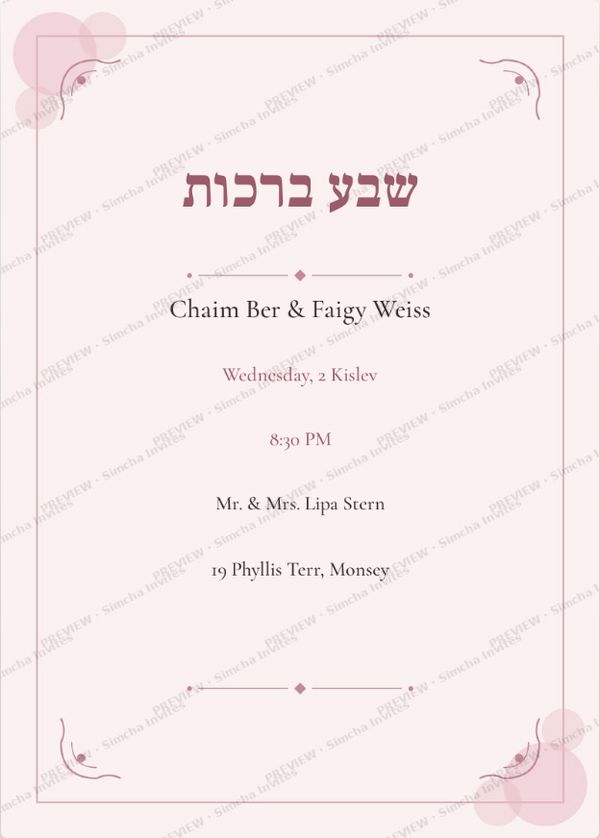
Simcha Invites has a Sheva Brachos category with a ready design that carries the heading שבע ברכות. You type the host, the night, the time and the address, see a live preview, and download a print PDF, a full-quality JPG and a small JPG for texting, for $15.
Panim chadashos and the Shabbos Sheva Brachos, in short
Panim chadashos (פנים חדשות, "new faces") means a guest who was not at the earlier celebrations and whose coming adds to the simcha. Hosts often invite at least one such person so the full Sheva Brachos can be said. Who counts as panim chadashos has details; ask your Rav.
On Shabbos, many poskim hold that Shabbos itself counts as panim chadashos for the Friday-night meal and the Shabbos-day meal, because of the extra honor of the day. For seudah shlishis, opinions and customs differ. This is one reason why so many families make a "Shabbos Sheva Brachos", with the couple staying with one of the families. Ask your Rav how your family does it.
For an invitation, this matters in one practical way: invite the guests you need for a minyan and for panim chadashos ahead of time, and make sure the card or message reaches them early enough.
How families organize the seven nights
Usually one person keeps the list, often a parent or a married sibling of the chosson or kallah. A common way to do it:
- Before the chasuna, write down the seven days with their dates, and mark the chasuna as day one.
- Ask the parents of both sides which night or Shabbos meals they want to host. In many families each side hosts at least one meal.
- Offer the other nights to grandparents, married siblings, uncles and aunts, close friends, the chosson's chavrusa or yeshiva friends, or a neighbor who asked.
- Decide on Shabbos: where the couple will stay, and who hosts each of the Shabbos meals.
- Write each host's name, address and time in the schedule table (below), and check that no two meals clash and that the drive between them works.
- Make one schedule card for the close family, and a host card for each night that invites more people.
- Send a reminder on the morning of each night, especially to the guests who make the minyan.
Leave a quiet evening if the couple needs one. Many hosts keep the meal short and warm rather than long and late, because the couple has a meal every night that week.
The 7-night schedule template
Copy this table into a note on your phone or a spreadsheet, and fill it in as hosts say yes. It keeps everyone on the same page, and it becomes the text of your schedule card.
| Night | Day and date | Host and address | Time |
|---|---|---|---|
| 1 (chasuna) | ___day, ___ / Hebrew ___ | The chasuna seudah, ___ Hall | Chuppah ___ |
| 2 | ___day evening, ___ / Hebrew ___ | ___, ___ (address) | ___ PM |
| 3 | ___day evening, ___ / Hebrew ___ | ___, ___ | ___ PM |
| 4 | ___day evening, ___ / Hebrew ___ | ___, ___ | ___ PM |
| 5 | ___day evening, ___ / Hebrew ___ | ___, ___ | ___ PM |
| 6 | ___day evening, ___ / Hebrew ___ | ___, ___ | ___ PM |
| 7 | ___day evening, ___ / Hebrew ___ | ___, ___ | ___ PM |
| Shabbos (if in the week) | Friday night, Shabbos day, seudah shlishis | ___, ___ | After davening |
Two tips for the table. First, a Sheva Brachos on a weekday evening falls after nightfall, when the Hebrew date has already moved to the next day; write the Hebrew date of that night (many cards write אור ליום with the next day). Second, if the Shabbos falls on one of the seven days, the Shabbos meals take the place of a weekday evening for that day, so the table may have fewer separate evening rows. Ask your Rav how to count the days if you are unsure.
What goes on a host's Sheva Brachos card
- The opening: בעזהשי"ת, ב"ה or בס"ד.
- The heading: שבע ברכות (on our design it is built in).
- Who is inviting: the host family.
- In whose honor: the chosson and kallah by name, and often their parents, the mechutonim.
- The day, the parsha and the Hebrew date (or אור ליום).
- The time.
- The place: the host's home, a shul hall or a small hall, with the full address.
- Optional: a phone number for the host, or "a minyan for maariv at ___".
Sample host card in lashon kodesh
A classic card from a host family, for example the kallah's married sister:
הננו מתכבדים להזמין את כבודו
להשתתף בסעודת
שבע ברכות
לכבוד החתן ___ נ"י
והכלה ___ תחי'
שתתקיים אי"ה ביום ___ פרשת ___
(אור ליום ___ ___ לחודש ___)
בשעה ___ בערב
בבית ___
___ (address)
המתכבדים
___ ומשפחתו
When the hosts are the parents of one side, they often honor the other side's parents too:
בשבח והודי' להשי"ת
הננו מתכבדים להזמין את כבודו ואת ב"ב שיחיו
לסעודת שבע ברכות
לכבוד צאצאינו היקרים
החתן ___ נ"י והכלה ___ תחי'
ולכבוד מחותנינו היקרים
ר' ___ הי"ו וב"ב
אי"ה ביום ___ פרשת ___ בשעה ___
בבית ___, ___
___ וזוגתו
Sample host card in Yiddish
מיר לאדענען אייך הערצליך איין
צו א סעודת שבע ברכות
לכבוד דעם חתן ___ נ"י
און די כלה ___ תחי'
___ טאג צו נאכטס, פרשת ___
___ אזייגער
ביי ___
___ (address)
מיר ווארטן אייך מיט פרייד
___ און משפחה
A friends' Sheva Brachos, for example made by the chosson's chaburah in the Beis Medrash, in a simple Yiddish style:
די חברים לאדענען איין
צו א שבע ברכות
לכבוד אונזער חבר דער חתן ___ נ"י
___ טאג נאך מעריב, ___ אזייגער
אינעם זאל פון ___
___
Sample host card in English
We are honored to invite you
to a
Sheva Brachos
in honor of the chosson and kallah
___ and ___
___day evening, Parshas ___
at ___ PM
at the home of ___
___ (address)
___ and ___ ___
A simple bilingual card: put the Hebrew on top and one English line underneath for guests who don't read Hebrew, for example "Sheva Brachos for ___ and ___, Wednesday evening at 8:00 PM, at the ___ home, ___."
More samples for different hosts
From the grandparents
When grandparents host, they often name the couple as their grandchildren:
בשבח והודי' להשי"ת
הננו מתכבדים להזמין את כל המשפחה שיחיו
לסעודת שבע ברכות
לכבוד נכדינו היקרים
החתן ___ נ"י והכלה ___ תחי'
אי"ה ביום ___ פרשת ___
בשעה ___
בביתנו, ___ (address)
הזקנים
___ וזוגתו
An out-of-town Sheva Brachos
Sometimes one night is in the other family's city, for example the chosson's hometown, so the local family and shul can share in the simcha. Give clear directions, because many guests will not know the home:
The ___ family invites you to a
Sheva Brachos
in honor of ___ and ___
who are visiting ___ this week
Thursday evening, Parshas ___, at 8:00 PM
in the hall of ___ (shul), ___ (address, city)
Parking: ___
Questions: ___ (phone)
A schedule card in Yiddish
דער סדר פון די שבע ברכות
פאר ___ נ"י און ___ תחי'
מיטוואך צו נאכטס · ביי ___ · ___ · 8:00
דאנערשטאג צו נאכטס · ביי ___ · ___ · 8:00
שבת קודש פרשת ___ · ביי ___
זונטאג צו נאכטס · ביי ___ · ___ · 7:30
מאנטאג צו נאכטס · ביי ___ · ___ · 8:00
מזל טוב!
A short note to the minyan
שבע ברכות היינט ביינאכט ביי ___
מעריב ___ אזייגער, סעודה גלייך דערנאך
מיר רעכענען אויף אייך פארן מנין!
Small things that help the host
- Ask the couple's parents what time works. The couple may come from another meal or a long drive; a fixed time on the card helps everyone.
- Say who should come. If the night is for close family only, a personal message is better than a card posted in a big group.
- Put maariv on the card if men will daven together first. It also helps gather the minyan on time.
- Keep a printed copy of the schedule on the fridge of both parents' homes. On Shabbos, nobody can check a phone.
- If something changes, send the new card with a short word such as "updated time" or שינוי, so nobody keeps the old one.
The schedule card for the whole week
A schedule card goes to the parents, grandparents, siblings and the closest relatives, so they know where to be each night. It is one card with all the nights. In lashon kodesh:
סדר סעודות השבע ברכות
לכבוד החתן ___ נ"י והכלה ___ תחי'
יום ___ פרשת ___ · בבית ___ · ___ (address) · בשעה ___
יום ___ · בבית ___ · ___ · בשעה ___
יום ___ · בבית ___ · ___ · בשעה ___
יום ___ · בבית ___ · ___ · בשעה ___
שבת קודש פרשת ___
סעודת ליל שבת: בבית ___
סעודת שבת: בבית ___
סעודה שלישית: ___
יום ___ · בבית ___ · ___ · בשעה ___
In English:
Sheva Brachos schedule
for ___ and ___
Wednesday evening · the ___ home · ___ · 8:00 PM
Thursday evening · the ___ home · ___ · 8:00 PM
Shabbos Parshas ___ · with the ___ family
Friday night, Shabbos day and seudah shlishis
Sunday evening · ___ Hall · ___ · 7:30 PM
Monday evening · the ___ home · ___ · 8:00 PM
Keep each night on one line: day, host, address, time, always in the same order. People read a schedule by scanning down, and a fixed order makes that easy.
A card for the Shabbos Sheva Brachos
When a Shabbos falls in the week, the host family often sends one card for the whole Shabbos. Because nobody can read a phone on Shabbos, this card must go out before Shabbos, with every detail guests need.
הננו מתכבדים להזמין את כבודו ואת ב"ב שיחיו
לסעודות שבע ברכות
בשבת קודש פרשת ___
לכבוד החתן ___ נ"י והכלה ___ תחי'
סעודת ליל שבת קודש: אחר התפילה
סעודת שבת: אחר התפילה
סעודה שלישית: בשעה ___
בבית ___, ___ (address)
___ ומשפחתו
If guests need to sleep over, add a line such as לינה לאורחים: ___ or tell them directly. Some families add a kiddush in shul for the couple on Shabbos morning; if so, give it its own line with the shul's name.
What each phrase means
| On the card | Meaning |
|---|---|
| סעודת שבע ברכות | A Sheva Brachos meal |
| לכבוד החתן והכלה | In honor of the chosson and kallah |
| ולכבוד מחותנינו | And in honor of our mechutonim |
| אור ליום | On the night before the day (the night belongs to the next Hebrew date) |
| סדר השבע ברכות | The schedule of the Sheva Brachos |
| סעודת ליל שבת קודש | The Friday-night meal |
| סעודה שלישית | Seudah shlishis, the third Shabbos meal |
| אחר התפילה | After davening |
| נ"י / תחי' | After the chosson's name / after the kallah's name |
| המתכבדים | The hosts who are honored to invite |
For more abbreviations, see our Yiddish and Hebrew invitation abbreviations guide.
The WhatsApp version
Most Sheva Brachos invitations go out on WhatsApp, often only a day or two before, because the week moves fast. Send the card as a picture with a short line of text. In Yiddish:
שבע ברכות לכבוד ___ נ"י און ___ תחי'
היינט ביינאכט, ___ אזייגער
ביי ___, ___
מיר ווארטן אייך!
In English:
For the minyan, a direct message works best: "We need you for the minyan tonight at 8:00, can we count on you?" A morning reminder on the day is common. Send the small picture file so it opens fast on every phone, including simple ones. Our guide to sending simcha invitations on WhatsApp or by text covers broadcast lists, groups and flip phones step by step.
When to send Sheva Brachos invitations
The schedule card commonly goes to the family a week or two before the chasuna, once the hosts are fixed. Host cards for each night often go out a few days before, with a reminder that morning. The Shabbos card must go out before Shabbos starts. These are common habits, not rules. For every simcha and its usual timing, see our guide on when to send simcha invitations.
Making a Sheva Brachos card on our site, step by step
- Open the Sheva Brachos category and tap the design. The heading שבע ברכות is part of the design.
- Type each text box: the opening, the chosson's and kallah's names, the day and parsha, the time, the host and the address. Hebrew, Yiddish, English or mixed all work.
- Choose a font for each box, and use A−/A+ to make a line smaller or bigger. Reset brings back the design's size.
- Check the live preview on your phone. For a schedule card, type all the nights and see if they fit at a size people can read. If they don't, use a short host card and send the full schedule as a text message.
- Place the order and pay $15. The preview is watermarked until you pay.
- Download your files: a print PDF, a "Full quality – for printing" JPG (2550 px wide, 300 dpi), and a "Small – for texting (MMS), under 1 MB" JPG for WhatsApp, text and email.
- For another night, make a new order with that night's details.
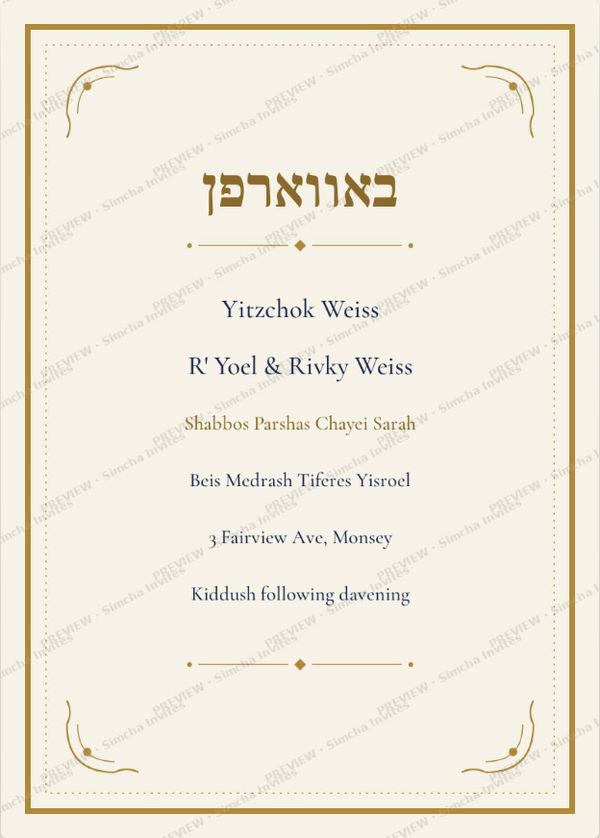
If the chasuna is still ahead, our chasuna invitation wording guide covers the wedding card, and our Bavarfen wording guide covers the Shabbos before.
Common mistakes
- Counting the days wrong. The chasuna day is day one. If the chuppah was after sunset, ask your Rav how to count.
- A weekday evening with the wrong Hebrew date. After nightfall the Hebrew date is the next day. Use אור ליום or check in a luach.
- Two hosts on the same night. One person should keep the master schedule.
- No minyan. Line up the men you need before the night, not at the table.
- The Shabbos card sent too late. It has to reach everyone before candle lighting.
- An address with no apartment number or no city. Couples and guests drive to a different home every night.
- Too much on one card. A schedule with seven lines plus directions gets crowded; keep extra details for a text.
Checklist for the host
- Your night is on the master schedule, with the right day and date.
- The chosson's and kallah's names are spelled the way the families spell them.
- Day, parsha and Hebrew date checked (with אור ליום for an evening if you use it).
- Time and full address on the card.
- A minyan lined up, and panim chadashos invited, as your Rav advises.
- The card sent a few days ahead, and a reminder that morning.
- For Shabbos: everything sent before Shabbos.
Frequently asked questions
How many Sheva Brachos are there?
The celebration lasts seven days, and the chasuna day counts as the first. In practice families plan about six more evenings, plus the Shabbos meals if a Shabbos falls in the week.
Who usually hosts the Sheva Brachos?
Parents of both sides, grandparents, married siblings, uncles and aunts, and close friends or the chosson's chaburah. Many families have each side host at least one meal.
What are panim chadashos?
A "new face": a guest who was not at the earlier celebrations and whose coming adds to the simcha. They are needed for the full brachos; the details are many, so ask your Rav.
Do you need panim chadashos on Shabbos?
Many poskim hold that Shabbos itself counts as panim chadashos at the Friday-night and Shabbos-day meals; for seudah shlishis opinions and customs differ. Ask your Rav.
Which Hebrew date goes on an evening Sheva Brachos card?
After nightfall the Hebrew date is already the next day, so many cards write אור ליום with that next day. Check it in a luach.
Should every night get its own card?
Not always. Close family often gets one schedule card for the week, and each host sends a card or a WhatsApp message to the wider guests of their night.
Can I put the whole week on one card?
Yes, as a schedule card, one line per night. Type it into the live preview first to see if it fits at a readable size.
Do you have a Sheva Brachos design?
Yes. Our Sheva Brachos category has a design with the heading שבע ברכות built in. You type the rest and download a print PDF, a full-quality JPG and a small texting JPG for $15.
How early should I send a Sheva Brachos invitation?
Commonly a few days before, with a reminder that morning; the full schedule often goes to family before the chasuna. See our timing guide.
Can I send the card on WhatsApp?
Yes. Send the small texting JPG with a short line of text. Our WhatsApp and text guide has the steps.
Can a Sheva Brachos be in a hall or a shul?
Yes. Many are at home, but a shul hall or small hall works well for a large family or a friends' Sheva Brachos. Write the hall's name and full address on the card.