Vort and L'chaim Invitation Wording (Yiddish, Hebrew & English)
How to invite family and friends to a l'chaim on the night of the engagement and to a vort a few days or weeks later, with sample wordings in Yiddish, Hebrew and English, short WhatsApp notices, and where the tenoyim fit in.
Updated November 8, 2026
Mazel tov! A shidduch was just closed
When a chosson and kallah become engaged, the news travels fast. Within an hour the phones are ringing, the neighbors are coming over, and someone is already asking, "When is the vort?" For the family, the first question is a practical one: how do we tell everyone where to come, and when?
This guide helps with exactly that. It explains the difference between the l'chaim (לחיים), which is often the same night, and the vort (ווארט), which is usually a larger gathering a little later. It shows where the tenoyim (תנאים) fit in, because families do this in different ways. Then you will find complete sample wordings in Yiddish, Hebrew and English, short messages for a same-night l'chaim, both-sides and one-side wording, a phrase table, a checklist and a list of common mistakes.
Customs around the engagement differ from community to community and even from family to family. What follows is common practice, not a rule. When in doubt, ask your parents, your mechutonim or your Rav.
L'chaim, vort and tenoyim: what is the difference?
The l'chaim (לחיים)
The l'chaim is the first, happy gathering right after the shidduch is decided. Very often it is the same night, at the kallah's home (in some families at the chosson's home, or wherever the families met). Close family, neighbors and friends hear the news and come to say mazel tov and make a l'chaim. It is usually informal: cake, drinks, maybe a few warm words. Because it happens within hours, there is no printed card. The "invitation" is a phone call, a WhatsApp message or a quick text.
The vort (ווארט)
The word vort means "word": the families have given their word to each other. In many yeshivish and modern heimish families, the vort is a bigger engagement party held a few days or a few weeks after the l'chaim, often in a hall or a large home, so that friends of both families, the chosson's yeshiva friends and the kallah's friends can come. This is the event that usually gets a real invitation, sent by WhatsApp, text or email, and sometimes printed.
The tenoyim (תנאים)
The tenoyim are the written conditions of the engagement, read aloud, after which the mothers break a plate. When they are written depends on the family's custom:
- In many chassidish families, the tenoyim are written at the engagement itself, on the same night or at the engagement gathering, and the whole simcha is often simply called "the vort" or "the tenoyim".
- In some families, the tenoyim are written at the vort, a few days or weeks later.
- In many yeshivish (Litvish) families, the tenoyim are written on the day of the chasuna, before the chuppah, and the vort has no tenoyim at all. (For the chasuna card itself, see our chasuna invitation wording guide.)
So one family's "vort" is another family's "tenoyim", and a third family has both on different nights. Your invitation should use the name your family actually uses, and say plainly what will happen that night if guests might be unsure.
| Event | When (common practice) | Where | How guests are invited |
|---|---|---|---|
| L'chaim | Often the same night as the engagement | Usually the kallah's home | Phone call, WhatsApp or text, within hours |
| Vort | A few days to a few weeks later | A hall, a shul hall or a large home | A designed invitation by WhatsApp, text or email; sometimes printed |
| Tenoyim | At the engagement, at the vort, or before the chuppah, by custom | Wherever that event is held | On the engagement or vort invitation, with the heading תנאים when the tenoyim are written |
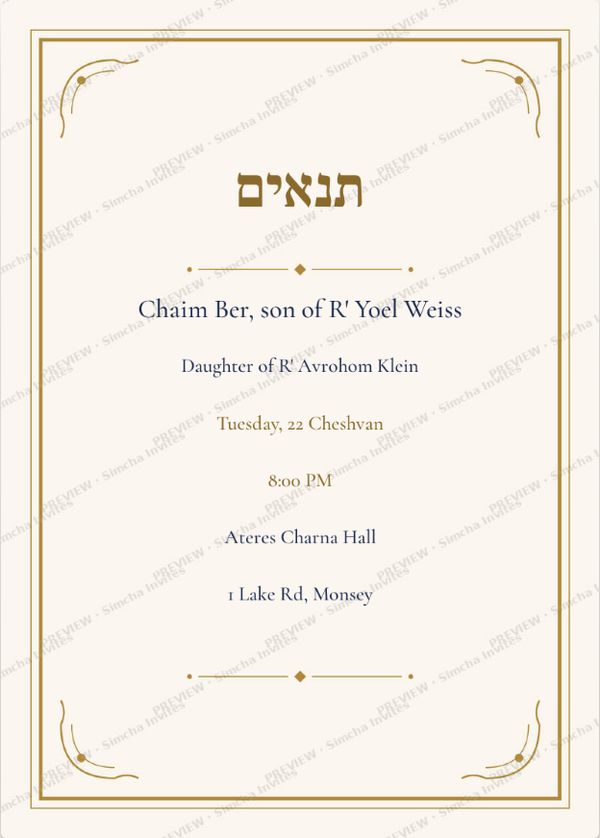
What goes on a vort or l'chaim invitation
A same-night l'chaim message can be three lines. A vort invitation has a little more. Here is the full list; take what fits.
- An opening line: ב"ה or בס"ד, often followed by thanks to Hashem, for example בשבח והודי' להשי"ת.
- The heading: לחיים, ווארט, שמחת האירוסין or תנאים, whichever your family uses.
- Who invites: both sets of parents together, or one side.
- The chosson and kallah: the chosson's name with נ"י, the kallah's name with תחי', joined by עב"ג.
- The other side's parents: when one side invites, name the other side with respect, as בת הרה"ח ר' ______ or בהרה"ח ר' ______.
- The day and date: the weekday, the parsha (לסדר ______), the Hebrew date, and for English readers the civil date.
- The time: a start time, and for a vort often an end time too ("8:00–11:00 PM"), so guests know they can come any time in between.
- The place: the hall or home, with a full street address and city.
- Practical notes if needed: separate entrances, parking, "the tenoyim will be written at 9:30".
- A closing line: המצפים לקבל פניכם בשמחה or in Yiddish מיר ווארטן אייך מיט פרייד.
Same-night l'chaim: short WhatsApp and text messages
On the night of the engagement nobody makes a designed card. You want a short message that people can read in five seconds and forward to their families. Give the names, the address and a time window. Here are messages you can copy.
English
L'chaim tonight at our home, ______ (address), until 12:00.
Please share with family and friends.
______ and ______ ______
Yiddish
אונזער טאכטער ______ תחי'
איז געווארן א כלה מיט ______ נ"י
בהרה"ח ר' ______ הי"ו פון ______
מען מאכט לחיים היינט ביינאכט
ביי אונז אינדערהיים, ______ (אדרעס)
ביז 12 אזייגער
______ ומשפחתו
Hebrew
בשעטו"מ
הננו להודיע על אירוסי בתנו ______ תחי'
עב"ג ______ נ"י
בהרה"ח ר' ______ הי"ו
הלחיים יתקיים הערב בביתנו
______ (כתובת), עד השעה 12
______ ומשפחתו
From the chosson's side, when the l'chaim is at the kallah's home
The L'chaim is tonight at the kallah's parents' home, ______ (address), from 10:00 PM.
We will be there and would love to see you.
______ and ______ ______
Tip: when the l'chaim is at the other family's home, ask them first before sending their address to your whole contact list. Agree together how late guests can come.
Vort wording in Hebrew (lashon kodesh), both sides together
This is the most common shape for a printed or designed vort card: one invitation from both families, with both sets of parents at the bottom.
בשבח והודי' להשי"ת
הננו מתכבדים להזמין את כבודו ואת ב"ב שיחיו
להשתתף בשמחת האירוסין של צאצאינו
החתן המופלג ______ נ"י
עב"ג
הכלה המהוללה ______ תחי'
אשר תתקיים אי"ה בשעטו"מ
ביום ______ לסדר ______, ______ תשפ"ז לפ"ק
בשעה ______ עד ______ בערב
באולם ______, ______
המצפים לקבל פניכם בשמחה
הורי החתן: הרה"ח ר' ______ הי"ו וזוגתו תחי'
הורי הכלה: הרה"ח ר' ______ הי"ו וזוגתו תחי'
שמחת האירוסין means "the simcha of the engagement". Some families prefer שמחת ההתקשרות or simply write the word ווארט as the heading in large letters. צאצאינו ("our children") is used when both families invite together.
Vort wording in Yiddish, chassidish style, with tenoyim
In many chassidish families the tenoyim are written at the engagement gathering. Then the card says so, and often the heading is תנאים or ווארט with the tenoyim time underneath.
מיט שבח והודי' צום אייבערשטן
לאדענען מיר אייך הערצליך איין
צו דער ווארט פון אונזערע קינדער
החתן ______ נ"י
עב"ג
הכלה ______ תחי'
וואס וועט פארקומען אי"ה בשעה טובה ומוצלחת
אום יום ______ פרשת ______
פון ______ אזייגער אוונט
אין זאל ______, ______
שרייבן תנאים: ______ אזייגער
אייער קומען וועט פארגרעסערן אונזער שמחה
______ ומשפחתו · ______ ומשפחתו
The line שרייבן תנאים: ______ אזייגער ("writing the tenoyim at ___ o'clock") is helpful for close family and friends who want to be there for the plate-breaking. If the tenoyim will not be written that night, simply leave the line out.
Vort wording in English, yeshivish style
An English vort card is often short and friendly. Many families in yeshivish circles write the vort without tenoyim, since the tenoyim will be written at the chasuna.
we invite you to join us at the
Vort
of our children
______ and ______
Sunday, ______ 2026, Parshas ______
8:00 – 11:00 PM
at ______, ______
Mr. and Mrs. ______ · Mr. and Mrs. ______
You can add a line for the yeshiva or seminary friends, for example: "Friends of the chosson from Yeshivas ______ are warmly invited." It is a small touch that makes the bochurim feel welcome.

One-side vort invitations
Sometimes each side sends its own invitation. This is common when the families live in different cities, when each side has a large circle of friends, or when there are two vorts, one in each city. Each side writes its own child first and names the other side's father with his full title.
From the kallah's side (Hebrew)
הננו מתכבדים להזמינכם להשתתף
בשמחת האירוסין של בתנו
הכלה ______ תחי'
עב"ג החתן המופלג ______ נ"י
בהרה"ח ר' ______ הי"ו מ______
אשר תתקיים אי"ה ביום ______ לסדר ______
בשעה ______ בביתנו
______ (כתובת)
ההורים: ______ ומשפחתו
From the chosson's side (Yiddish)
מיט גרויס פרייד לאדענען מיר אייך איין
צו דער ווארט פון אונזער זון
החתן ______ נ"י
עב"ג הכלה ______ תחי'
בת הרה"ח ר' ______ הי"ו מ______
אום ______ פרשת ______
______ אזייגער אוונט
אין ______, ______
______ ומשפחתו
From the chosson's side (English)
invite you to the Vort of their son
______
to ______, daughter of Mr. and Mrs. ______ of ______
Tuesday, ______ 2026, at 8:00 PM
at ______, ______
When there are two vorts, say which city on each card, and do not send one family's card to the other family's whole list without asking. People sometimes come to the wrong city.
Bilingual card: Hebrew on top, English below
Many families have relatives who read only English. A bilingual card keeps everything on one picture: the Hebrew wording first, then a short English summary with the essentials.
הננו מתכבדים להזמינכם לשמחת הווארט של צאצאינו
החתן ______ נ"י עב"ג הכלה ______ תחי'
ביום ______ לסדר ______ בשעה ______
באולם ______
______ evening, ______ 2026, from ______ PM
at ______, ______
The ______ and ______ families
Keep the English to the names, day, time and place. If you try to translate every line of the Hebrew, the card gets crowded and the text gets small on a phone.
Including grandparents and other family
Grandparents are often written under the parents, especially on a both-sides card:
זקני הכלה: הרה"ח ר' ______ הי"ו · הרה"ח ר' ______ הי"ו
Some families leave grandparents for the chasuna invitation and keep the vort card simple. Whatever you choose, keep both sides balanced: if one side lists grandparents, the other side should too. If the vort is hosted at a grandparent's home, it is nice to say so: בבית זקננו הרה"ח ר' ______ הי"ו, or in English "at the home of the kallah's grandparents, Mr. and Mrs. ______".
Phrases on a vort or l'chaim card, and what they mean
| Phrase | Meaning | Where it goes |
|---|---|---|
| ב"ה / בס"ד | Baruch Hashem / with the help of Heaven | Top of the card |
| בשבח והודי' להשי"ת | With praise and thanks to Hashem | Opening line |
| בשעטו"מ | In a good and successful hour | Near the date, or as a blessing at the top |
| שמחת האירוסין | The simcha of the engagement | Heading or first line |
| ווארט / לחיים | Vort / l'chaim | Heading, in large letters |
| צאצאינו | Our children | When both families invite together |
| בננו / בתנו | Our son / our daughter | When one side invites |
| עב"ג | With his (or her) match | Between the chosson's and kallah's names |
| נ"י / תחי' | May he be well / may she live | After the chosson's / kallah's name |
| בהרה"ח / בת הרה"ח | Son of / daughter of (with title) | Naming the other side's father |
| אי"ה | If Hashem wills | Before the date |
| לסדר ______ | In the week of Parshas ______ | With the date |
| תשפ"ז לפ"ק | The year 5787 (2026–27) | After the Hebrew date |
| המצפים לקבל פניכם בשמחה | Looking forward to greeting you joyfully | Above the signatures |
For more abbreviations and titles, see our guide to Yiddish and Hebrew invitation abbreviations.
When the tenoyim are written: use a Tenoyim card
If your family writes the tenoyim at the engagement or at the vort, the event is a tenoyim simcha, and a card with the heading תנאים is the natural choice. Our Tenoyim designs include a Both Sides design and 10 decorative Tenoyim Frame designs. Our Tenoyim wording guide has full sample wordings, titles and a line-by-line explanation.
To be clear: we don't have designs with a ווארט or לחיים heading yet. Every design on our site has a fixed Hebrew heading, so a Tenoyim card fits only when tenoyim are actually written that night. For a vort without tenoyim, the wording samples on this page work on any card your family likes, or as a simple WhatsApp message.
Making a Tenoyim card on our site, step by step
- Open the Tenoyim category. Go to Tenoyim designs and pick a design. The Both Sides design (Tenoyim – Ivory Frame) has a text box for each line.
- Type your text in each box. Each box is for one part of the card (for example the names, the date, the place). You can type in Hebrew, Yiddish, English or a mix. Copy the wording from this page or the Tenoyim guide and fill in the blanks.
- Choose a font for each box. Each text box has its own font picker, so the names can be in a bold Hebrew font and the address in a simpler one.
- Adjust the size. Use A− and A+ to make text smaller or bigger, and Reset to go back. Long names often need one step smaller so they fit on one line.
- Check the live preview. Tap on text on the card to jump to its box. Look at it on your phone, because that is where most guests will see it.
- Show the other side. Send a screenshot of the preview to the mechutonim before you pay. Names and titles are the most common thing to fix.
- Order and pay. Each invitation is $15. Before payment the preview is watermarked.
- Download your files. You get three: a print PDF, a "Full quality – for printing" JPG (2550 px wide, 300 dpi) and a "Small – for texting (MMS), under 1 MB" JPG for WhatsApp, text and email.
Sending the invitation
Most vort invitations today are sent by WhatsApp or text. Send the small texting file, not the big print file: it opens quickly and stays sharp on a phone, and it goes through on most phones, including kosher and flip phones that receive picture messages. Put a short line of text with the picture (names, day, time, address) so that people who can't open pictures still have the details. Our guide on how to send simcha invitations on WhatsApp or by text has step-by-steps for iPhone, Android, WhatsApp and flip phones, and sample messages.
A message to send with the vort picture
Timing: when to send
A l'chaim message goes out the same night, as soon as the families agree to share the news. Many families wait until close relatives (grandparents, married siblings, rebbeim) have heard by phone before posting it in groups, so nobody important hears it second-hand.
A vort invitation usually goes out as soon as the date and place are set, often several days to a week or two before, depending on how soon the vort is. If the vort is the same week, send it right away and send a short reminder on the day. For more, see our guide on when to send simcha invitations.
Checklist before you send
- Both families agree on the heading: לחיים, ווארט, שמחת האירוסין or תנאים.
- Both families agree on whose names come first and how they are written.
- The chosson's and kallah's names are spelled the way each family spells them, in Hebrew letters and in English.
- Titles (הרה"ח, מו"ה, הי"ו) are written the way the other family likes.
- Weekday, parsha and Hebrew date match each other on a luach.
- Start time, and end time if you want one.
- Full address with city; the hall name and any entrance note.
- If tenoyim are written: the time, so family can be there.
- The other side has seen the final version.
- You checked the picture on a phone, not only on a computer.
Common mistakes
- Sending before both sides agree. The news of a shidduch belongs to both families. Agree on the wording and the moment to share it.
- Calling it tenoyim when no tenoyim are written (or the other way around). Guests who want to see the plate-breaking will come at the wrong time, or not come.
- The wrong weekday for the date. If the card says Tuesday and the date is a Wednesday, half the guests will ask. Check on a luach.
- Forgetting that the evening belongs to the next Hebrew day. A vort on Sunday night is, by the Hebrew calendar, already Monday's date. Decide whether you write the date of the day or of the night, and keep it consistent with the weekday.
- No address. "At the kallah's home" is not enough for people from out of town. Write the street and the city.
- Too much English. On a bilingual card, a full translation makes everything small. Give English readers the essentials.
- Sending the big print file on WhatsApp. It is slow to open and some phones can't receive it. Send the small texting file.
- Unbalanced names. Grandparents on one side and not the other, or a title for one father and not the other, can hurt feelings.
Frequently asked questions
What is the difference between a l'chaim and a vort?
A l'chaim is the small, happy gathering right after the engagement, often the same night at the kallah's home. A vort is usually a larger engagement party a few days or weeks later, often in a hall, with its own invitation. Some families have only one of the two.
Are tenoyim written at the vort?
It depends on the family. Many chassidish families write tenoyim at the engagement itself, some families write them at the vort, and many yeshivish families write them on the day of the chasuna before the chuppah. Ask your family which custom you follow.
Do you need a printed card for a l'chaim?
Usually not. A l'chaim is often the same night, so families send a short WhatsApp or text message with the names, the address and the time.
Who sends the vort invitation, the chosson's side or the kallah's side?
Often both sides together on one card. When the families live in different cities or each has a large circle, each side may send its own card, writing its own child first.
Whose names come first on a both-sides card?
On many Hebrew cards the chosson's parents are on the right and the kallah's parents on the left, but some families put the hosting side first. Agree on it with the mechutonim before the card is made.
What does עב"ג mean?
It stands for עם בת גילו, "with his match". It joins the chosson's name to the kallah's name on engagement and wedding cards.
What heading should a vort card have?
Families write ווארט, לחיים, שמחת האירוסין or, when the tenoyim are written, תנאים. Use the name your family and community use.
Do you have vort or l'chaim designs?
Not yet. Our designs have fixed headings, and we have Tenoyim designs with the heading תנאים, which fit when the tenoyim are written at the engagement or the vort.
How much does a Tenoyim invitation cost on your site?
$15 per invitation, and you get a print PDF, a full-quality JPG and a small JPG for texting.
Should I write an end time on a vort invitation?
Many families do, for example "8:00–11:00 PM". It tells guests they can come any time in that window, which helps a busy evening run smoothly.
Can I send the invitation to people with kosher phones?
Many kosher and flip phones can receive picture messages. Send the small texting file and include the details as text in the same message, in case the picture does not open.
What if there are two vorts, one in each city?
Make two cards, each with its own city, date and address, and send each card to the right list. Mention the city clearly so nobody goes to the wrong one.
Wishing you much simcha
An engagement is one of the happiest moments for a family. Keep the l'chaim message short and quick, give the vort invitation a little more care, agree on everything with the other side, and check it once more on your phone before it goes out. Mazel tov, and may you merit to build a בית נאמן בישראל.