Bar Mitzvah Invitation Wording (Yiddish, Hebrew & English)
Bar Mitzvah invitation wording made simple: what to include, sample Hebrew/Yiddish and English wording, and tips for hall, time and grandparents' names.
What a Bar Mitzvah invitation includes
- The heading: בר מצוה.
- The bar mitzvah boy's name, and the parents' names.
- The day and Hebrew date, and the time of the seudah.
- The hall or shul with the full address.
- Grandparents' names, if the family wants them on the card.
Sample wording in Hebrew / Yiddish
הננו מתכבדים להזמינכם להשתתף
בשמחת הבר מצוה של בננו היקר
______ נ"י
שתתקיים אי"ה ביום ______ לסדר ______
בשעה ______ באולם ______
ההורים: ______
Sample wording in English
we invite you to join us at the
Bar Mitzvah of our dear son
______
on ______, at ______ PM
at ______ hall, ______
Parents: ______ · Grandparents: ______
Quick checklist
- Check the Hebrew date against the English date.
- Write the hall's name exactly as it appears on its sign.
- Put the time of the seudah, not the time doors open, unless you want both.
- Send it two to three weeks before.
Why the wording matters
A bar mitzvah is the first simcha that is really the boy's own. The invitation goes to family, rebbeim, neighbours, his classmates' parents and the whole kehilla, and many of them will keep it on the fridge until the night of the seudah. The wording does not need to be fancy. It needs to be clear, warm and correct: the right title after every name, a Hebrew date that matches the English date, the parsha, the time, and an address nobody has to call about. Below you will find full sample wordings in Yiddish, in לשון קודש and in English, an explanation of every line, a table of titles, and a checklist you can go through before you send it out.
Sample wording in Yiddish
Many heimish families write the invitation in Yiddish, with the names and the opening lines in לשון קודש. This is a simple, warm version for a seudah in a hall:
מיט שבח והודי' צום אייבערשטן
לאדן מיר אייך הארציג איין צו נעמען אנטייל
אין דער שמחת בר מצוה פון אונזער טייערן זון
החתן בר מצוה ______ נ"י
וואס וועט פארקומען אי"ה
אום יום ______ פרשת ______, ______ תשפ"ז לפ"ק
אין זאל ______, ______
די סעודה הייבט זיך אן ______ אזייגער אוונט
אייער קומען וועט פארגרעסערן אונזער שמחה
המצפים לקבל פניכם בשמחה
______ ומשפחתו
A shorter Yiddish version, good for a card with a busy design and little room for text:
מיר לאדן אייך איין צו דער בר מצוה סעודה
פון אונזער זון ______ נ"י
אי"ה יום ______ פרשת ______
______ אזייגער · זאל ______
______ ומשפחתו
Sample wording in לשון קודש with grandparents
A more formal version, written fully in לשון קודש. It names the father with his titles and adds both sets of grandparents at the bottom:
בשבח והודיה להשי"ת שהחיינו וקיימנו והגיענו לזמן הזה
הננו מתכבדים להזמין את כבודו ואת ב"ב שיחיו
להשתתף בשמחתנו בהגיע בננו היקר
ה"ה החתן בר מצוה ______ נ"י
לעול מצוות
הסעודה תתקיים אי"ה ביום ______ לסדר ______
______ תשפ"ז לפ"ק, בשעה ______ בערב
באולם ______, ______
בואכם יגביר שמחתנו
ההורים: הרה"ח ר' ______ הי"ו וזוגתו תחי'
הזקנים: הרה"ח ר' ______ הי"ו · הרה"ח ר' ______ הי"ו
Some families prefer to write the grandparents as הוריו and הורי זוגתו, or to name them in the signature line: ונכדו של הרה"ח ר' ______ הי"ו. Both are common. If a grandparent is no longer alive, many families still include the name with ז"ל or ע"ה, and some leave grandparents off the card altogether. Do what your family has done at earlier simchas, so that nobody feels left out.
Tefillin, aliyah and kiddush lines
A bar mitzvah often has more than one event: the boy starts putting on tefillin, he gets an aliyah on Shabbos, there is a kiddush after davening, and there is the seudah. Some families put everything on one card; others make one card for the seudah and mention the rest in a short line underneath. Here are lines you can add.
Hanachas tefillin
בביהמ"ד ______, ______
בשעה ______ אינדערפרי אין ביהמ"ד ______
Many families do not print a line for tefillin at all and simply tell close family the time. If you do print it, a separate small line at the bottom of the card is enough.
Aliyah and kiddush on Shabbos
בביהמ"ד ______
ואחר התפלה קידושא רבא
אין ביהמ"ד ______, נאכן דאווענען קידוש
The seudah
The seudah is the main event and normally gets the biggest line. If the seudah is on a weeknight, write the day, the parsha and the time. If it is on Shabbos (a seudas Shabbos at home or in the shul hall), write בשב"ק and say whether it is the night meal or the day meal:
בליל שב"ק פרשת ______ אחר התפלה
בבית ______, ______
A boy who says a pshetel (drasha) at the seudah does not need a line on the card, but some families like to add החתן בר מצוה נ"י יאמר דברי תורה. That is a nice touch, not a requirement.
Sample wording in English with grandparents
An English card works well for relatives and friends who do not read Hebrew, or as the back side of a Yiddish card:
we are honored to invite you
to the Bar Mitzvah of our dear son
______
The seudah will take place, im yirtzeh Hashem,
on ______, Parshas ______
______ 2026, at ______ PM
at ______ hall, ______
Hanachas tefillin: ______ at ______ AM, ______ shul
Your presence will add to our simcha
Mr. and Mrs. ______
Grandparents: Mr. and Mrs. ______ · Mr. and Mrs. ______
In English there is no need to translate the titles. "Mr. and Mrs." or "Rabbi and Mrs." is fine, and it reads naturally. If you write the Hebrew date on the English card too, put it after the English date, for example "Tuesday, October 20, 2026 · 9 Cheshvan 5787".
Line by line: what each phrase means
| Phrase | Meaning | Notes |
|---|---|---|
| ב"ה / בס"ד | Baruch Hashem / B'siyata d'Shmaya | At the very top of the card. Pick one; not both. |
| בשבח והודיה להשי"ת | With praise and thanks to Hashem | A classic opening for a bar mitzvah. Yiddish: מיט שבח והודי' צום אייבערשטן. |
| שהחיינו וקיימנו והגיענו לזמן הזה | Who kept us alive and brought us to this time | Optional, adds warmth. Used on formal cards. |
| הננו מתכבדים להזמין | We are honored to invite | The standard way to invite in לשון קודש. |
| את כבודו ואת ב"ב שיחיו | You and your household | Literally "your honor and your household, may they live". A polite way to invite the whole family. |
| בהגיע בננו היקר לעול מצוות | When our dear son reaches the yoke of mitzvos | The formal way of saying "his bar mitzvah". |
| ה"ה | Hu hu, "that is" | Placed before the boy's name: ה"ה החתן בר מצוה. |
| החתן בר מצוה | The bar mitzvah boy | On a bar mitzvah he is called the "chosson". |
| נ"י | Nero yair | After the boy's name. |
| שתתקיים אי"ה | Which will take place, if Hashem wills | Before the date. Yiddish: וואס וועט פארקומען אי"ה. |
| לסדר / פרשת | Of the parsha | The week is named after the parsha read that Shabbos. |
| לפ"ק | Lifrat katan | After the Hebrew year. |
| בואכם יגביר שמחתנו | Your coming will add to our joy | A warm closing line. Yiddish: אייער קומען וועט פארגרעסערן אונזער שמחה. |
| המצפים לקבל פניכם בשמחה | Looking forward to greeting you joyfully | Just above the signature. |
| ומשפחתו | And his family | After the father's name in the signature. |
Titles and honorifics: which one to use
The small titles before and after the names are where most families slow down. There is no single rule for every kehilla, but this table shows how they are usually used on a bar mitzvah card.
| Title | Full form | Who it is for |
|---|---|---|
| הרה"ח | הרב החסיד | Before the name of a father or grandfather in a chassidish family: הרה"ח ר' יעקב. |
| הרה"ג | הרב הגאון | For a rav or a well-known talmid chochom. |
| מו"ה | מורנו הרב | An older, formal title before a man's name, often used for grandfathers: מו"ה משה. |
| ר' | רבי | The plain, everyday title before a man's name. |
| בהרה"ח | בן הרב החסיד | "Son of": החתן בר מצוה ______ נ"י בהרה"ח ר' ______ הי"ו. |
| ה"ה | הלא הוא | "That is", before the boy's name. |
| נ"י | נרו יאיר | After the bar mitzvah boy's name. |
| הי"ו | ה' ישמרהו ויחייהו | After a grown man's name: the father, grandfathers, uncles. |
| שיחי' | שיחיה / שיחיו | After a living person's name, or a whole family: ב"ב שיחיו. |
| תחי' | תחיה | After a woman's or girl's name: וזוגתו תחי'. |
| שליט"א | שיחיה לאורך ימים טובים אמן | After the name of a rav or rebbe. |
| ז"ל / ע"ה | זכרונו לברכה / עליו השלום | After the name of someone who has passed away. |
A simple way to remember it: the boy gets נ"י, the men get הי"ו, the women get תחי', and a rav gets שליט"א. הרה"ח and מו"ה are titles of respect before the name; many families use הרה"ח for the father and both grandfathers so that nobody is "less" than anyone else. If you are not sure, look at the last invitation your family sent, or ask a parent. Families differ, and what your family writes is the right answer for you.
Writing the Hebrew date and the parsha
A bar mitzvah is on the boy's Hebrew birthday, thirteen years after he was born, but the seudah is not always on that exact day. Write the date of the event, not the date of the birthday. A full Hebrew date line has these parts, in this order:
- The day of the week as a letter: יום א' for Sunday through יום ה' for Thursday, ערש"ק for Friday, שב"ק for Shabbos and מוצש"ק for Motzei Shabbos.
- The parsha: on a weekday write לסדר or פרשת with the parsha read the coming Shabbos.
- The Hebrew day and month: ט' מרחשון.
- The year with לפ"ק: תשפ"ז לפ"ק.
- The time, and whether it is morning or evening.
Put together it reads: ביום ג' לסדר לך לך, ט' מרחשון תשפ"ז לפ"ק, בשעה 7:30 בערב. Remember that the Hebrew day starts at nightfall. A seudah on Wednesday night is already Thursday on the Hebrew calendar, so many families write ליל ה' (the night of Thursday) or simply write the English day and time to avoid confusion. When in doubt, check the date in a Hebrew calendar and ask someone to read the finished line once more.
The time and the hall line
Write the time guests should come, and say whether it is the reception (קבלת פנים) or the seudah itself. If you want both, two short lines are clearer than one long one:
הסעודה: ______ בערב
For the hall, write the name exactly as it appears on the sign, then the street and number. If the hall has two rooms, name the room. If parking or a ladies' entrance matters to your guests, a few short words help: "parking in the back" or כניסה לנשים מצד ______. Keep it short. The invitation is not the place for directions; most guests will type the address into their phone.
Common mistakes to avoid
- The wrong title on the boy. The boy gets נ"י, not הי"ו. הי"ו is for the grown men.
- A Hebrew date that does not match the English date. Check both, and remember that an evening event belongs to the next Hebrew day.
- The birthday instead of the event. Write the day of the seudah, even if the actual bar mitzvah day was a few days earlier.
- Mixing ב"ה and בס"ד. Use one at the top of the card.
- Forgetting the year with לפ"ק. It is small, but guests notice when it is missing.
- Leaving out a grandparent. Read the grandparents' line aloud with your spouse before you send.
- Spelling the hall's name from memory. Copy it from the hall's own card or sign.
- Too many lines. Tefillin, aliyah, kiddush, seudah and directions on one card can crowd the design. Keep the seudah large and the rest small.
Full checklist before you send
- ב"ה or בס"ד at the top.
- The boy's full name, spelled the way he signs it, with נ"י.
- The father's name with the title your family uses (ר', הרה"ח or מו"ה) and הי"ו.
- The mother written as וזוגתו תחי', or both parents in the signature.
- Grandparents on both sides, in the order your family agreed on.
- The day of the week, the parsha, the Hebrew date and the year with לפ"ק.
- The English date, if you have an English side or English-speaking guests.
- The time of the seudah (and the reception, if different).
- Tefillin, aliyah or kiddush lines, if you want them on the card.
- The hall's name and full address.
- One person who did not write the card reads it all the way through.
- Send it two to three weeks before, and a short reminder a day or two before.
Make your Bar Mitzvah card on our site, step by step
- Pick the design. Open the Bar Mitzvah designs and tap the one you like. The heading is already part of the picture, so you never type it.
- Type each box. Every box has a label that says what it is for: the boy's name, the day and date, the time, the hall, the parents and the grandparents. You can type in Hebrew, Yiddish, English or a mix. You can also tap a line on the card to jump straight to its box.
- Choose a font and size. Each box has its own font picker and A− / A+ buttons. Most families make the boy's name the biggest line and keep the tefillin or aliyah lines a size smaller.
- Check the preview. The card updates as you type. Look at it once at phone size, because that is how most guests will see it. The preview has a watermark; the paid files do not.
- Place the order and pay. The price is $15. On designs that have an animated GIF version, you can add the GIF for a small extra.
- Download your 3 files. Right after paying you get a print PDF (letter size), a Full quality JPG for printing (2550 px wide, 300 dpi) and a Small – for texting JPG under 1 MB for WhatsApp, text messages and email. GIF orders also get the GIF and a small GIF. Save the page so you can download again later.
For how to send the small file to many people at once, see our guide to sending simcha invitations on WhatsApp or by text.
Sending it on WhatsApp or printing it
Most bar mitzvah invitations today go out on WhatsApp and by text, and some families also print a few copies for grandparents and for the shul. Send the small texting JPG to the groups, and print the PDF or the full-quality JPG for paper copies. On designs that have an animated GIF version, the GIF looks lovely when it opens on a phone. A day or two before the seudah, send a short reminder with the time and the hall.
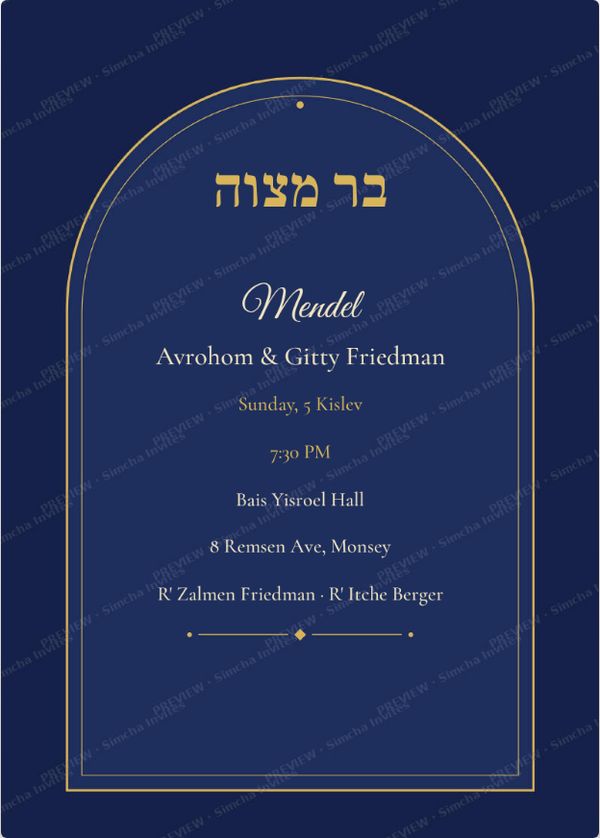
More complete samples for different family situations
Named after a grandfather (lashon kodesh)
בשבח והודי' להשי"ת
הננו מתכבדים להזמין את כל קרובינו ומכירינו
להשתתף בשמחת הבר מצוה
של בננו החתן בר מצוה ______ נ"י
הנקרא על שם זקנו הרה"ח ר' ______ ז"ל
אשר תתקיים אי"ה ביום ______ לסדר ______, ______ תשפ"ז לפ"ק
בשעה ______ בערב, באולם ______
ההורים: ר' ______ הי"ו וזוגתו תחי'
Twin boys (lashon kodesh)
הננו מתכבדים להזמינכם להשתתף בשמחת הבר מצוה
של בנינו התאומים
החתנים בר מצוה ______ נ"י ו______ נ"י
אשר תתקיים אי"ה ביום ______ לסדר ______
בשעה ______, באולם ______
At the grandparents' shul, out of town (Yiddish)
מיט גרויס פרייד לאדענען מיר אייך איין צו דער
בר מצוה
פון אונזער זון ______ נ"י
שבת קודש פרשת ______
עליה לתורה און קידוש אינעם ביהמ"ד פון זיידע, ______
______ (address, city)
אורחים פון אויסערהאלב: ביטע רופט ______ פאר א שלאף-פלאץ
Yeshivish style, in English, with a schedule
With gratitude to Hashem
Rabbi and Mrs. ______
invite you to join them at the
Bar Mitzvah
of their son ______
Tefillin: Thursday, ______, Shacharis 7:00 AM, ______ shul
Seudah: Sunday, ______, 7:30 PM, ______ hall
Aliyah and kiddush: Shabbos Parshas ______, after davening
One simcha, several events: what to write for each
A bar mitzvah often has more than one event. This table shows the usual events and the line that goes with each. Families do it differently; print only what you want guests to come to.
| Event | When (common practice) | Line on the card |
|---|---|---|
| Hanachas tefillin | Before the bar mitzvah; customs differ, ask your Rav | הנחת תפילין תהי' אי"ה... |
| The bar mitzvah day | The Hebrew birthday at 13 | ביום ______ לסדר ______ |
| Seudah | That night or a nearby evening | הסעודה: ______ בערב |
| Aliyah and kiddush | A Shabbos around the bar mitzvah | העלי' לתורה... ואחר התפלה קידושא רבא |
If the birthday is in Adar, or the boy was born at night, ask your Rav which day is the bar mitzvah before you print the date.
More mistakes to avoid
- Two cards that don't match. If you send a seudah card and a separate Shabbos card, use the same spelling of every name on both.
- No Shabbos note for out-of-town guests. When the aliyah is out of town, add one line about where guests can stay, so they can plan before Shabbos.
- Sending the big print file on WhatsApp. The small texting JPG opens faster and stays sharp; save the print files for paper.
- Typing the heading again. בר מצוה is already in the design; start your first box with the opening line or the parents.
For a girl's simcha, see our bas mitzvah invitation wording guide.
Frequently asked questions
What does החתן בר מצוה mean?
It means "the bar mitzvah boy". On a bar mitzvah card the boy is called the chosson, and his name follows with נ"י.
Should the invitation be in Yiddish or לשון קודש?
Both are common. Many heimish families write the opening and the names in לשון קודש and the rest in Yiddish. A formal card is often fully in לשון קודש. Follow your family's style.
Do I put the tefillin time on the invitation?
Only if you want guests to come. Many families tell close family the tefillin time and print only the seudah. If you print it, add one small line at the bottom.
When should I send a bar mitzvah invitation?
Commonly about three to six weeks before a seudah in a hall, and a little less for a small seudah at home, with a short reminder a day or two before. See our guide on when to send simcha invitations.
Which title goes after the father's name?
Usually הי"ו after the name, with ר' or הרה"ח before it. The mother is written as וזוגתו תחי'.
How do I word a bar mitzvah for twins?
Write בנינו התאומים and then החתנים בר מצוה with both names, each with נ"י. Many families write the older twin first.
Which file should I send on WhatsApp?
Send the Small – for texting JPG. It is under 1 MB, so it opens fast and stays sharp on WhatsApp and picture messages. Print the PDF for paper copies.
Can I write whom the boy is named after?
Yes, if you like. A line such as הנקרא על שם זקנו ר' ______ ז"ל is used by some families; many leave it off.
Can the boy's name be bigger than the other lines?
Yes. On our site every text box has its own font and A− / A+ size buttons, so you can make the name the biggest line.